Blogger seems to have stopped working. I can’t preview or publish the long-overdue conclusive post of my summer travels, so I have decided to change platforms in the hope that WordPress will be easier to use and more reliable. I’ll be migrating all my previous content from Blogger to here, which is no easy task. Please stay tuned !
Occasionally I have that dream where I’m walking through something that’s thick, something hard to move through. Like honey – or tar ? I think a lot of people have them. Symptoms of stagnation that I reckon many people would agree with.
Imagine driving on sand (I never have but I dreamt this and I think it’s kind of the same) – you drive, but your steering is sluggish because you have little grip. Eventually you get stuck, and you can hear the engine screaming as the wheel spins through the sand but you don’t move.
Like the other dream you want to move, but you can’t. I’ve seen on tv and in movies that characters will go and put a plank of wood under the wheel, so it bites and you break loose from the sand.
The plank seems unnecessary to pull me out of my creative rut. When I walk on sand, I feel it between my toes. It rubs my skin, and every centimetre feels the contact and the grip that lets me walk through it. When waves break and the surf rushes up to meet my stride the grip loosens at first but then hardens again, and I walk stronger.
And I hear, and see, these waves much better when I’m no longer inside the car.
It is inconceivable that one’s mind should simply wonder to the ticket booth at the Tate Modern and ask for the price of admission of the latest Rothko or Hirst exhibition. Descartes would have had some strong words about this notion – it’s a bit complicated to leave behind your physical self when the two are intrinsically intertwined.
Yet we are experiencing a moment in the practice of curation where the delivery of artistic material to the minds of many may no longer depend on a physical presence of the consumer. The closure of both private and public institutions, museums and galleries in the wake of the (ongoing, wear your f*cking mask!) pandemic has left many in the art world scratching their brains as to how the consumption of art can continue behind closed doors. Luckily the digital age we live in has managed to find a temporary fix to satisfy the needs of people interested in art.
Louis Vuitton Foundation, Paris.
Cindy Sherman (1954-), prolific “Pictures Generation” American artist focusing mostly on photography, is on show at the Louis Vuitton Foundation in Paris. Or rather, she should have been, and I should have been to see it. A collection of her works from 1975 onwards, including the notable Untitled Film Stills and Sex Photos, this exhibition was meant to show a critique of established conceptions of identity, femininity in the fashion and cinema industries. It is now available in an online tour, hosted by the curators of the Louis Vuitton Foundation.
Untitled #475, Cindy Sherman, 2008.
It opens many questions on the nature of experiencing artwork. The phrase “this art speaks to me” is not just a hipster catchphrase but a reflection of the social bond being formed between the art and the viewer through a moment of uncertainty. Abductive reasoning – Gell (1998)’s theory argued that art could “create” its own meaning and a rapport with a viewer upon being observed. If this is the case then it fundamentally demands the presence of a physical person to complete this two-way social interaction from which meaning can be determined. I wonder to what extent the lack of a physical mediator takes away from Gell’s process, therefore devaluing the artwork and not allowing it to entrance its viewer in the same natural way that Gell would have us see it. Certainly, this reality allows for the access to and ability to accumulate cultural capital that Bourdieu would see as crucial for the cultural differentiation of the non-distinctive human body (Keat, 1986). In a public health scenario this is ideal.
It is fitting that Cindy Sherman’s work is almost entirely focused on criticising the roles of the body in society, with particular note to the role of the female body taking positions of power in the cinema industry. Untitled Film Stills (1977) projects Sherman, a woman, into traditionally roles of producer, director, photographer as well as model and actress. Her work transgresses established norms in this industry, and through single frames she is able to tell a whole story that throws down challenges to these norms.
Untitled #84, Cindy Sherman, 1978. (Film Stills).
The virtual environment gives the curators absolute power over the viewing experience of Sherman’s work. A blessing and a curse as it would seem to interfere with Gell’s process, yet through proper delivery the body of work can be exhibited with flair and style whilst staying true to the motivations of the artist – and through this proper delivery, much to the credit of the curators of the FLV, their chronological curation of Sherman’s work could potentially lend itself to a Gell-like process that distills the intended meaning in a viewer in a natural way, perhaps even sidestepping the evident barrier that is a computer or phone screen.
Sex Photos removes Sherman from the work almost entirely. Just as we, the viewer, are removed from the gallery the artist is removed from the work in favour of mannequins in grotesque situations. The criticism of the highly-sexualised female form in contemporary mass media is evident, and in some frames Sherman can be glimpsed as a reflection in an object in a Baudrillard-esque simulacrum, or Platonic shadow or what is a true human being and by extension, a woman.
Untitled #250, Cindy Sherman, 1992. (Sex Photos).
Gell’s dialogue between art and viewer is in this series being held between a representation of Sherman and a digital interface of the viewer – the relationship between human and art has been reduced to a completely abstract and intangible one in these times. Further dehumanisation of the human form through the Clown Series serves only to remind us, the viewer, that the times of pandemic have been complicit in the depriving of basic artistic interactions that illustrate the blank cultural canvases of our bodies (Bourdieu, 1985).
Untitled #417, Cindy Sherman, 2004. (Clowns).
This is not to say that online renditions of exhibitions like Cindy Sherman à la Fondation are “good” or “better” – these words are not part of the discussion. This examination of the online dimension to artistic media reveals the subtleties of how humans interact with art and culture, and how times of extreme circumstances have forced a re-thinking of these interactions. The very meaning of art is fundamentally linked to the experience of being in front of it, with one’s own two eyes. But perhaps in the future the experience learnt from the pandemic and through efforts like The Fondation Louis Vuitton will reveal a new dimension for the consumption of a different form of art.
Hosted at the Carpenter’s Workshop Gallery, British designer and artist Paul Cocksedge’s newest series of work is a mind-bending challenge to the limits of the material world, drawing inspiration from the industrial as well as the natural. Slump is an interactive and immersive vision of interior design that elegantly manipulates light, whilst pushing the physical limits of glass to technical extremes.
Slump as a title is somewhat of a misleading one – the implied lethargy, laziness and exhaustion are the very antithesis of the reality of Slump’s highly technical and arduous manufacturing process. The entire collection exudes tension when the processual side of Slump is taken into account. The glass is stretched under high temperatures and “slumped” over natural and industrial material, including steel, concrete rock and wood. After hardening over a period of up to 72 hours the result is a smooth and crystal-clear glass surface that coats and accentuates the contours of the supporting bases.
Bubble Table, 2020. Glass and mild steel.
The use of patinated mild steel in pieces like the Bubble table are critical to Paul’s desire to give the materials space to breathe. The metal tubing’s form that just peeks through the glass echoes the effect of rippling water, commanding a calming presence completely at odds with the intensity of the heat and force of the manufacturing process.
Rock Coffee Table, 2020. Glass and rock.
The protective, calm nature of the slumped glass is taken a step further with the Rock coffee table series, and the accompanying Log. Again, imagery of rushing water is invoked, with slightly more irregular shapes betrayed by the glassy caps. The Rock series plays with light even further, with the underside of the glass surface being textured as to let through a beautiful pattern of light when seen from above. This play with light is reminiscent of the reflection of an aquatic surface, and Paul’s inspiration is clear – half submerged rocks and logs in the Hackney Marshes are the primary source for the series of coffee tables.
Concrete Console, 2020. Glass and concrete.
As a collaborative, UK-based project that has come to fruition thanks to the help of a multitude of highly-skilled craftspeople and specialised techniques and machines, Slump is summed up in the Concrete Console. Like the project as a whole, the console is a collaboration of the various themes that Slump has toyed with, distilling light, materiality and tension into one. This console acts as a final piece to describe the journey of Cocksedge’s Slump, mixing different concretes and shapes that lay down the final conclusion to the series. Pipes, pillars and columns hold up the signature slumped glass in an aesthetic full-stop that once again hammers home the contrasting yet complementary themes of calm and tension that characterise this body of work.
The fog seems to blur my
vision and my perception. Am I drunk? My mind is clouded with a fuzzy lethargy
that pins me to the platform seat in a stupor.
The station is in the middle of two hills. They are desolate; blanketed in long grasses undulate softly in the mid-afternoon wind rolling through the valley, lending a shimmering effect to the silvery-green hillsides like passing waves. I don’t remember how I got here. I don’t think I am waiting for a train, and I don’t think I was ever on a train. There is a little shed with stone stairs in the distance on the hillside opposite me. It is run down, a sad shade of brown that blends into the swathes of greyness that shroud the sky, hills and my eyes.
The woman and the man are sat
on the stairs, talking. She is beautiful. He is tall, with a strong five
o’clock shadow that highlights his rugged jawline and his dark features. I
cannot be sure who he might be. The remains of my attention are consumed, and I
am distracted from the damp bench and the raging pain behind my eyes and in my
temples.
Across the grasses, just as
the station clock reminds me it’s 16:30, another man is making his way up the
stone stairs. He seems preoccupied, and his gait is nervous and agitated. Among
the folds of his white shirt and grey overcoat a gleam of brushed silver
catches my gaze as he strides up the stairs two at a time. A shade of silver
that seems to snarl angrily from his belt at my watering eyes, yet I feel
noticeably calm and detached.
My vision starts to become
increasingly foggy and the pain becomes more intense. My mouth is dry, and I
seem to be sweating in the cold September air.
The man reaches the top of
the stairs. The couple seem to have gone inside the shack, I cannot see them
anymore. He pauses outside the splintering door, and enters brusquely. I cannot
hear anything but my straying mind tells me they are having an argument. The
grasses roll on in the wind, ruffling my hair and blowing open my jacket. Tears
bleed from my eyes as I pass into darkness.
He is next to me. He smells of cigarettes. How did he get here? How long have we been sharing the same damp bench on the same isolated platform? The pain in my head sears and my delirium strangles me, his image becomes unclear and dissolved. He says something. His voice is alien and distorted, like a badly tuned radio.
I am on a train. I don’t know where it’s going. He is gone. My consciousness seems to be skipping parts of my day like a scratched record. The fire in my head and my eyes has reduced to a dull throbbing, and I am aware of rain trickling down the window like the tears rolling down my cheeks. Where am I going? Where is the man, the woman and her friend?
The train sails on through
the lonely moor.
I cannot hear the rabble of
the other passengers. The noise has been drowned out by the two gunshots that
suffocate and cling to me like the heavy, dead weight of the gun in my belt.
Tears stream uncontrollably from my eyes and blend into the tiny flecks of
crimson on my white shirt and grey overcoat.
The fog in my eyes retreats, and fades into the background like the distant platform and the memory of my wife and her lover.
The spaces around us manipulate our every interactions out in the world. The forces manipulating these spaces are invisible: designers and architects and city planners pulling invisible strings that spawn “one-way” and “please do not sit on the grass” signs in areas that you’d never think twice about. These strings would be of notable interests to anthropologists of the likes of Bruno Latour and Tim Ingold, both masters in theorising how people interact directly and indirectly with the material world around them.
But it is someone like Tim Ingold who can help bridge a gap between understanding one’s position in public and/or private spaces. I recently spent a week in Paris and the thought that constantly filled my mind was the difference in organisation of public space and places, and how people interacted with them compared to London. Ingold argues that one cannot understand space and landscape without moving through it – that is to say, experiencing it and living in it. This “insider’s view” is critical to understanding how landscape and space interact with and are affected by culture, and conversely, how culture affects them. Not having ever spent much time in Paris I was very much coming in with a newcomer’s eye. The differences I perceived between Paris and London relate more to public space rather than the private. Museums and street-side bistros were the focal points of my attention in regards to this topic.
It was Jean-Jacques Rousseau who made the connection first that structures of power are made to control the people, but someone like Michel Foucault more directly tackles the issue of architecture and institutionalised violence being agents in the domination of common people by the elite (Foucault, 1977). A Foucauldian analysis of institutionalised violence permeating through architecture is something that always resonates with me in London, places like Buckingham Palace and the Horse Guards (despite being inherently public/tourist areas) still represent a divide in power and separation of space between the common people and a residual force of autocratic monarchy. French history of course saw the monarchs’ heads roll back in 1789, and conversion of previous Royal estate like the Louvre into public museums marks for me one of the most significant remodelling of violent and oppressive spaces within a city. This kind of remodelling of public space is a more effective way of decolonising space whilst effectively retaining a cultural and architectural heritage. It speaks to the finesse and respect that the French cultural identity places upon artistic and aesthetic quality even whilst reconciliation this identity with a less violent and Foucauldian separation of space prior to a social revolution.
The bistro is an extremely Parisian setting. Sitting out on the street with a coffee and book or a beer and a cigarette is something that seem inherently Parisian to me and certainly is an association that a lot of people have with this city. Restaurants and bars in London at least are always hard to find and isolated from the main streets. Dingy, crowded stuffy bars are swapped out for open air bistros that spill out onto the pavements in an inherently more socialised and public experience for communal drinking and relaxing. The fact that one can sit in a French bistro and order a single coffee and thereafter spend as long as one wants seated outside with a book is testament to the inherently more social side to eating and drinking that exists in France. Spaces and places are not just green-screen-esque backdrops for sociocultural activity, but as Eric Hirsch (1995) argues, the relationship between culture and nature is more of a complicated symbiotic relationship constantly interacting with itself to reflect the actual experience of social aspects like sitting in a bar. Locked away inside and away from the public eye stigmatises and elevates the exclusivity of social gatherings, in contrast to being in plain sight of the public, also a means to extend a small social gathering to a larger public of passer-bys. The establishment of more public social spaces, like the bistro, is one of several reasons that I feel that anthropologically speaking Paris accommodates a much more open and inclusive social scene where there are little to no social borders between people, and one where the social “backdrop” works conceptually in unison with a sociocultural identity.
As Ingold argues, moving through a space is the best to understand how it functions in relation to the individual and their experience of the space around them as well as the experience of social interactions within public spaces. I had only known Paris to the extent of a few tourist places with my family many years ago, but rediscovering it with new eyes allows one to see through into the intricate mechanisms that makes this city feel so alive and so vibrant.
Foucault, M (1977) Discipline and Punish: The Birth of the Prison. London: Penguin
Hirsch, E. and O’Hanlon, M. (eds) (1995). The Anthropology of landscape: perspectives on place and space. Oxford: Oxford University Press.
INGOLD, T (2000). The perception of the environment: Essays on livelihood, dwelling and skill. London: Routledge.
Recently a stalwart feature of logging into BBC News or the Guardian every morning on my phone revolves around anything from freak storms to intentional burning of acres and acres of cherished rainforest. We’re talking none other than climate change, global warming, or whatever you would like to call the situation of impending doom.
This isn’t hyperbolic of me, I haven’t been kept awake at night by monsters for a very long time but this is a monster that I think keeps many of us up at night in existential fear at the state of affairs. As the youth become more and more exposed to and engaged in the reality of the situation through social media and trailblazers (pun not intended) like Greta Thunberg, who galvanise the masses of the youth into actually caring about the environment ravaged by profit-driven governments and big corporations.
GCSE Geography is great. Learning about the greenhouse effect is great. It teaches the kids the bare minimum about how it is that every year seems to be the “hottest July ever”, but withholds the darkest shade to the capitalist machine that does nothing but take from the earth – the aptly named Cowspiracy.
Documentaries like Netflix’s Cowspiracy is propaganda in its purest form. It scares you, draws back the curtain, reels you in, engages you personally until you reach the same conclusion that I did: animal agriculture and the mass production of meat and dairy products is singlehandedly the most damaging business to our planet’s environment and climate, and there are people actively seeking to cover this fact up and protect this industry.
Even though I am aware that Cowspiracy is a propaganda piece, I respect it for working and happily accept that I fell for it. Which might not be such a bad thing. Kip Andersen’s frustrating and laboured journey to uncover the truth behind the massive power that the agriculture industry and lobbies hold over climate activists and climate organisations is well-constructed and lends itself well to the heavily guarded secrets that are the side effects of mass livestock farming. For example, the wastage of water growing beef especially is astounding – to produce one pound of beef (453.6g) takes 2,500 gallons (9,463.6 litres). All this waste leaving the animal agriculture industry responsible for 18% of global greenhouse gas emissions every year. The reality of raising animals for food on such a massive scale is completely unsustainable in terms of space and resources. Driving your car is insignificant in comparison to the methane-producing machine that churns out burger patties and milk every single day.
Why more people don’t know about this? Lobby groups (in America at least) have kept a stranglehold on the information surrounding how damaging animal industry is, trying to keep a system that promotes the mass production and commodification of luxury foods like meat running so that they can fill their pockets while the environment crumbles. The availability of meat is insane, when you think that you can buy a coaster-flavoured puck of beef rammed between soggy buns for £4.99. The mass production is a problem. And to feed and water the 1,5 billion cattle alive today, vast forests are cleared to grow crops like soy, of which 70% of the global consumption of soy is claimed by livestock. A meat-centred diet is a commercial and capitalist fabrication to ensure that the industry can continue allowing animals and the environment to needlessly suffer when there are much better and healthier alternatives.
Going plant-based, or vegan, is the obvious and most eco-friendly solution. I found the resolve to make this change in the wake of watching Cowspiracy, and for a week and a half I got to grips with plant-based diets before coming to a realisation – going vegan is excellent, but it is also unsustainable and not accessible. I found myself constantly hungry, lacking in variety and most importantly, broke. Veganism is expensive. Veganism is limiting. It’s healthy for sure, but it is also repetitive. In my opinion going plant-based is not a viable solution to the problem given that there are 8 billion people on this planet, many of whom can’t afford soy meats and milk alternatives, or have even heard of them. I came to this conclusion regretfully as I embarked on this mission to change my habits with passion and determination. However, going vegetarian is a step in the right direction, and to be honest one finds oneself eating vegan most of the time anyways. Milk, butter, meat, fish are out. Vegetables are the new cool.
Veganism is the ideal that everyone should strive for, but for those who cannot go all the way going vegetarian is good enough. It’s about reducing, and managing what we eat and where it comes from. It is the most accessible and realistic expectation if we want to help solve the climate issue by tackling people’s unhealthy and un-environmentally friendly diets. Let meat and fish and other animal products stay as luxuries, as they should be, perhaps ensuring a better future for these animals as well as the environment.
*this is the most recent post that is actually on this blog. The conclusion to my summer travels, and a long-overdue one. Thank you for waiting, and I hope you have enjoyed reading this blog’s travels*
It’s taken a broken adaptor and couple of days for me to separate myself from my laptop screen, but said separation has allowed me to reflect on my time and enjoy the closing days to the maximum. As my grandmother rightly wrote to me, this trip deserves a conclusion and it would be insane to not give myself and whoever is actually reading this closure.
Claude Lévi-Strauss once wrote that “feasts are good for eating, drinking, and thinking“. It is on this thought that I have been dwelling in the last few days as I really felt myself and my ability to converse coming into their own. I’ve often interpreted Lévi-Strauss’ comment to take “thinking” as an overarching observation on the innate social effects that commensal eating and drinking have on human beings. Sharing is caring: whether it be sharing in an experience, or the last beer of an evening. Social bonds manifest themselves stronger when there is something to link the divide between two or more people. The divide in this case, can be a language barrier that frequently has had me at a loss in trying to communicate my desires, likes and plans through the often mysterious structure of Japanese.
My time living in a host family is exactly and more than what I expected, as I have mentioned briefly in previous updates. Japanese hospitality and kindness is unparalleled. My road trip to Shimane Prefecture last week with my host mother, her son and gramps allowed me to fully appreciate this for the first time. The seemingly mundane experiences of visiting a museum together, laughing over a meal that was too hot or reading a (ominous) fortune at the Izumo Taisha Grand Shrine might not be innately exciting, but these small things are what allow for a common ground to be forged between people that can make human interactions so valuable. Naturally, the beauty of what was visited must not be forgotten or underestimated, as all my experiences in Japan have been.
It also happened to finally coincide with the official end of the rainy season, as announced to me triumphantly by heralding in a scorching heat that persisted for the remainder of my time, embellishing the Adachi Museum of Art and the Grand Shrine much to their advantage.
The heat and a sky of perfect blue led me by the hand on Friday morning to the famous island of Miyajima. I was admittedly nervous as I was on my way to spend the weekend with Prof. Kitano and his class from the Hiroshima University of Economics; unsure if I would be an unwelcome presence or stick out like a sore European thumb. I was relieved to leave on Sunday after what could possibly have been one of the most happy and unique memories that I might have in my life so far.
(Kitano is the charmingly witty and ridiculously intelligent man who put me in contact with my host family). I received a VIP tour of the Itsukushima Shrine and the Daishō-in Temple by the vice-chief monk, and wrapped it up with an Okonomiyaki and grilled oyster lunch with Kitano. It was at this point that I met the class – third year media and business students, and for 2 days I felt as though I was one of them. We ate dinner together, drank (lots) together and talked until early. It felt as though Lévi-Strauss himself were perched on my shoulder, contently watching as we shared a communal Sukiyaki and as we slowly became better and better friends. I struggle to remember a different time where I have been more warmly welcomed immediately into a group without question.
To take things to a more poetic standpoint the climb up the albeit small Mt. Misen the next morning was an experience that slowly carved a bond out with every mossy, damp step that brought us closer to our goal. The reward of a view of the Seto inland sea, dotted with islands in the distance looked like a scene that could have been painted by Yokoyama Taikan in the halls of the Adachi Musuem. Islands shrouded by undulating mirages, with white beaches and tree-covered hills in a sea of deep deep blue. It is a view that for me might sum up my entire trip, tangible yet slightly surreal when I look back. An experience that stands as alone as some of the distant islands that I could see shrouded in excitement and mystery.
I’m glad and honoured that I made friends in that short period of time. After sitting in Japanese classes learning the formalities and grammar for 8 years, being able to kick back with a beer and casually joke about them with young people in casual Japanese is a reward unlike no other after so many years of studying and learning.
Hitching a ride back to Hiroshima on Sunday evening as passenger on Reishi’s motorbike was unbearably cool. I now understand why people ride motorbikes. He even invited me to the onsen and a dinner at his dad’s ramen restaurant. Pretty awesome guy.
I was sad to leave my host family and my new friends yesterday morning. However, all good things must come to an end. I wrote this whilst in transit in Hanoi, and the feeling of retracing my steps is nostalgic and is helping me to come to terms with the month that has just elapsed, and the things that I’ve done, seen, eaten, drank, the people I’ve met, the conversations I’ve had. It gives me a taste for more. More things that I can experience, more things that I can crystallise in my mind as invaluable memories. Travelling alone has provided the freedom that I crave to immerse myself into myself and the things that are happening directly around me at every second. I can think of no other time when I have not relished every single second of a day. The blog has more or less kept me in touch with the world, and you will be relieved to know that this is the end of travel blogging. Thank you for reading. Expect more and more varied blogs from here on out.
of the white eye sockets of the wives and children who did not return home
that tore apart our hearts
can it be forgotten?!
Tōge Sankichi, 1951
It seems only logical to me that places such as Hiroshima, and Nagasaki, are designed to crush your soul in the face of indescribable cruelty and horror with the intention of getting their message across. I thought I knew this by now, and would be able to handle the Atom Bomb museum in Hiroshima, and yet again I found myself weeping before what I saw and learnt.
Hiroshima carries a far greater symbolic meaning in the Japanese psyche. Being the first location of an atom bomb being dropped on people, and with a far larger death toll (140,000 are thought to have died by the end of 1945), Hiroshima stands proudly today as a symbol of exactly what the Japanese way of life is about. Getting back on ones feet. Forgiving, but never forgetting. Rebuilding and reforming, with a mission and a purpose. The peace memorial with its simple grace represents not only the horrors of war and the sacrifice of thousands, but also as a worldwide flagship for peace and a gathering place for movements for the abolishing of nuclear weaponry. The museum is sobering, naturally, it does not hide the truth and is to the point. There are no frills here. Such a message has no time for frills.
It is also here that I learnt that the dropping of the bomb on the 6th of August 1945 also killed hundreds of non-Japanese; among the dead were also southeast asian exchange students, Korean and Chinese immigrants, and even American prisoners of war. The loss of the innocent in times is a result of the hideous nature of such indiscriminate mass murder. And while every day, innocent children, women and men still die every day in less fortunate places, the lessons still don’t seem to have sunk in. War seemed to be an adequate excuse for accidentally vaporising people who bravely bade their time in prisoner camps, only to die at the hands of the ones they serve alongside their enemies, and it still seems to be adequate today. It was all well and good to sentence Nazis to death in Nuremberg in the 50’s, but what is happily brushed under the carpet and excused by wartime circumstances is the unquestionable crime against humanity that is the birth of nuclear weapons.
The famous atom bomb dome on the banks of the Motoyasu river in Hiroshima should stand forever as a painful reminder of what these weapons of mass destruction do to families, cities and nations until nuclear warfare is outlawed and removed from the surface of this planet. If Prometheus was banished to infinite suffering for stealing the secrets of fire, then perhaps a nuclear holocaust is what humanity deserves for trying to meddle with things that they shouldn’t.
A frail olive tree stands in the courtyard of the victim’s memorial, breaking its way through concrete towards the clouds with biblical determination.
The city of Hiroshima lives, just like Nagasaki, reborn and proud. Like every other Japanese city, the people of Hiroshima swamp the shopping streets, pile into pachinko parlours and crowd their local Okonomiyaki shops. This city lives for the future. I cheered myself up with a sushi lunch and followed it up by a trip to the Hiroshima Museum of Contemporary Art – hidden on a forestry hill in the east of the city, where signs literally banned some entrances due to very real danger of the local hornet population.
And on the topic of Okonomiyaki, dinner that night at home greeted me with a portable flat iron sitting on the dinner table – Okonomiyaki, homestyle. I’d eaten enough Okomiyaki in my life and watched enough youtube videos to really impress my host family with my pancake flipping skills, but of course i didn’t admit that.
This is a long post. But it’s an important one. It’s also important to never forget who the real war criminals are, and important to remember that those people will never face trial for their crimes against humanity, and the thousands of innocents who have died in Japan at the hands of these monstrosities will never know justice, only pain and sombre remembrance.
Hiroshima, Mon Amour – the feeling of romance and mystery perhaps wasn’t as strong as in Marguerite Duras’ film as a heavy sky heralded in my arrival to this city, although I avoided the summer rains just long enough to take a quick and wholesome look around the city. Also, someone shouted this blog out on the Oxlove Facebook page, so if you’re the kind poster and you’re reading this, this one’s for you.
I’ll preface this with a disclaimer that I am yet to see the more important and meaningful parts of the city. That is to say, the Atom Bomb museum, Peace Park and the famous Atom Bomb Dome still await me. I think Friday is the day for that. Anyways, yesterday, I got out of Hiroshima station and took a leisurely walk towards Shukkeien and the ruins of Hiroshima Castle. It was still dry, so the Shukkeien Garden was a pleasant if not slightly sweaty time. But in the long line of Japanese-style gardens, this one is also just as hard to fault or dislike.
Hiroshima Castle is described as a ruin on maps and on the internet, although what appeared before me was hardly a ruin. Sure, all the walls weren’t there, and some of the turrets were missing, but it’s easier for me to describe the castle in Kumamoto as a ruin compared to Hiroshima. The entireity of the main keep stood strong, imposing its five stories high above the rest of where the castle used to lie. Naturally it was all destroyed in the blast in 1945, but the reconstruction is so good that one could have thought it had been standing there forever. It’s at this moment that it started raining, and it seemed like a good idea to head back to the station before jumping on a train up to Kabe, where I have been warmly welcomed by the Yoshiokas, my host family until wednesday. My Japanese is really being put to the test now…
We ate, I showered, and went to bed, exhausted from finally being able to set myself down knowing that I didn’t have to move for a while now.
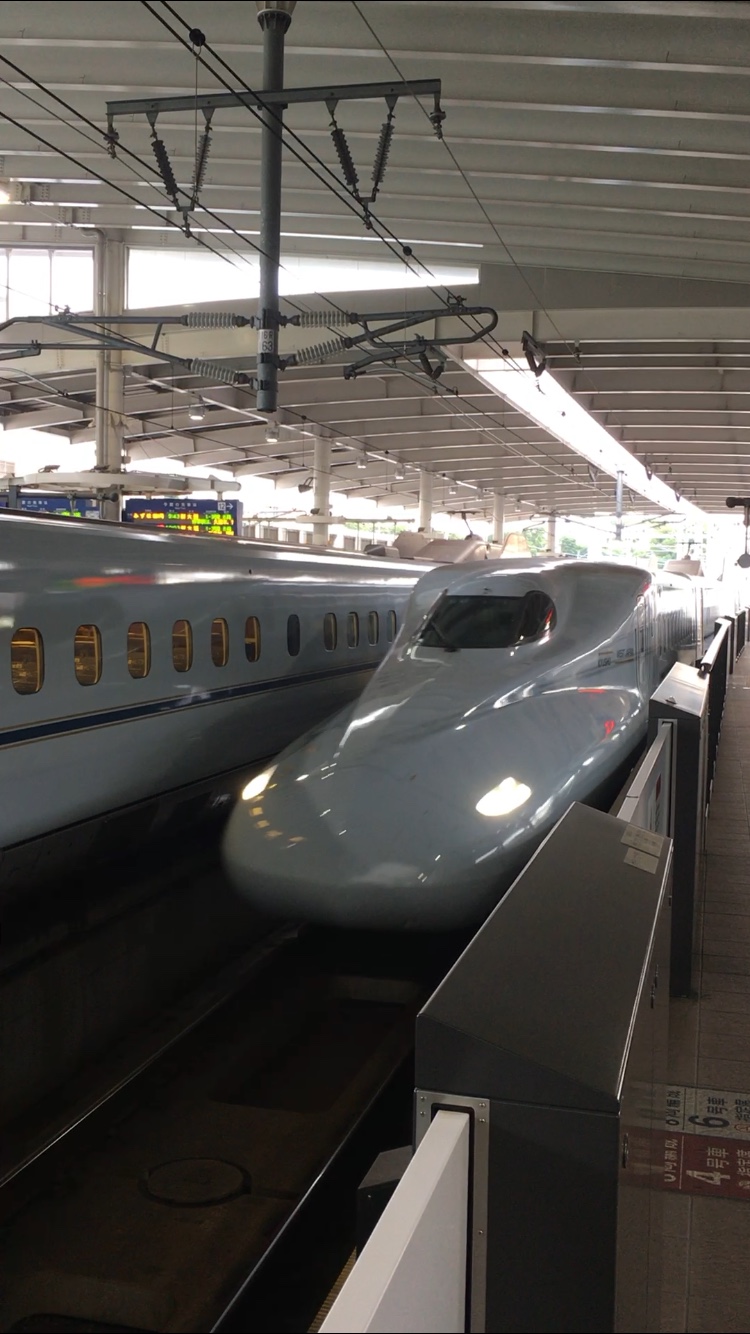
That didn’t last so long however, because at 10 this morning I hopped on a bullet train to Himeji – and and I’d like to sincerely thank whatever powers that be (God, Buddha, Shrek, or some nondescript deity who likes me) for letting the sun poke its shy head through the rainy season’s everlasting fog. I don’t think it would have been appropriate to see Himeji Castle, in six-story brilliant white glory in any other setting than in a blue sky. It doesn’t really need explanation. It’s huge, it’s beautiful, and I couldn’t help grinning like an idiot in awe at what I was witnessing and how lucky I was with the weather.
The accompanying Kōkoen garden was sublime. Probably the most beautiful I have seen. And I can comfortably say, I’ve been to a fair few. It’s crazy how much just a little bit of sunshine can make even small rocks or mossy lawns glow in an entirely mundane yet sublime beauty, one that Sōetsu Yanagi would have probably been infatuated with. I’m also reading his writing at the moment; The Beauty of Everyday Things. It seems appropriate given that I’m getting a lot of rain and am trying my damndest to appreciate things that I can see even if it pours from above.
It’s at this moment that it started raining like crazy, the moment I stepped out on to the platform at Himeji to go back to Hiroshima. It seems that I have made the most of my window of opportunity to experience real beauty, and that window seemed to have shut very abruptly and very timely on me. It seems that the one in charge of the weather thought I deserved a bit of relief.
Tomorrow I have no plans really, although I have a couple of ideas: Either I go to Osaka, or I want to return to Nagasaki to see the things I missed. I’m currently leaning more towards Nagasaki though, I felt like that city really clicked with me, and besides, it doesn’t feel right to give such a large city as Osaka only one day. Maybe that will be for the next time I come to Japan. In any case, who knows what tomorrow will bring ? The least I hope for is dry weather.
Being caught in the tail end of a subtropical typhoon wasn’t previously on my bucket list, but I guess that it is now is considering that I have now checked it off. I previously might have mentioned, back in Fukuoka or Kumamoto, that I’d never seen so much rain as I did – my saturday in Kagoshima steals top place on my “rain list” with ease. It felt like it was raining upwards, in the humble words of Forrest Gump. It was that kind of rain where it is more worth getting a taxi to walk a 10 minute walk between station and hotel.
Speaking of hotels, saturday was a bit of a disaster (momentarily). I had left Kumamoto having made a reservation in a little place called Ibusuki, south of Kagoshima city, maybe what I thought was half an hour by train. I swapped out the flashy bullet train for the local, rickety yet endearing local train, but found an entire hour’s journey south on an extremely bumpy ride that I genuinely thought would make me see my breakfast again.
Ibusuki was, and is, no doubt a charming seaside resort. The nearby Ikeda Lake and the hot sand onsens on the beach are a source of local pride, but with a ominous looking horizon and the realisation that the beach resort was miserably empty, run down, and my hostel so unbearably sad that I didn’t have the heart to commit to it. I cancelled my reservation (for free, luckily) and scooted back on the long ride back to Kagoshima city – where the storm hit, and everything turned a sad shade of dark, dark grey.
I was now in Kagoshima station with a deflated morale and no place to stay, so I desperately checked into the cheapest hotel I could find. I spent the rest of the day shut in, and my evening actually allowed me outside into what I quickly realised was the throbbing and packed red light district on a saturday night. I had a great meal, bought some beers in the convenience store and watched Blade Runner (2049) until I couldn’t keep my eyes open. Also, I ate horse sashimi. Maybe I’ll get some hate for this, but to me this isn’t a big deal. The horse that suffered momentarily for a part of my dinner last night probably lived a life that was far longer and a hundred times more pleasant than any other livestock animal that is more regularly consumed in our countries. Also, it was delicious, so maybe I’ll be eating Findus lasagnas again soon.
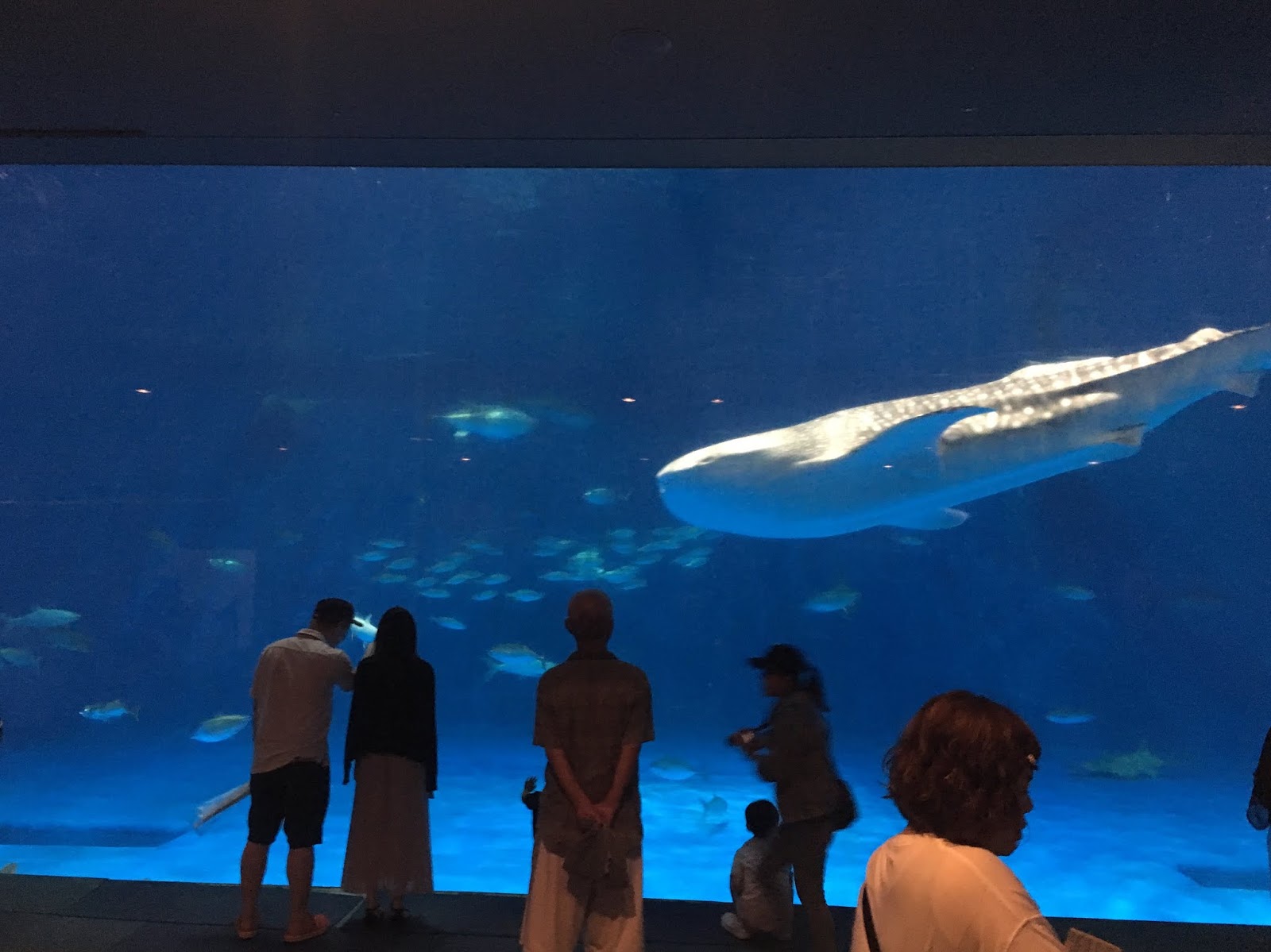
I awoke to a dry morning. Humid and still recovering from being battered by a storm the night before, I found the courage and the motivation to get out into town. I started by going to the aquarium in the harbour. It was fantastic. Aquariums are always special places, but coming off my thoughts on animal cruelty and treatment of animals, the presence of a whale shark in the largest tank, along with some rather sad dolphins that I saw in their tiny “pen” on the way in is an issue that I don’t think escapes criticism.
Small fish, I can understand, because you can give them larger tanks for their size (relatively speaking), but a whale shark doesn’t belong in a tank swimming around endlessly in circles for children to bang the glass and for obnoxious parents to snap flash photos when the signs clearly say to not to. I’m pretty certain that I saw many fish and sea life in the aquarium that seemed blind in one if not two eyes. Bittersweet, and definitely not worth £12, but the magical quality of aquariums is still undeniably alluring.
An aquarium seemed appropriate for the kind of weather that was ongoing. If you’re never sure when it might start pouring again, being inside is best. However, it was looking pretty dry so I decided to hop on the ferry to Kagoshima bay’s crown jewel, Sakurajima – Japan’s most active volcano, and said to be an impressive sight. And it is, even when the peak is shrouded in clouds and smoke. I even got a small ray of sunshine on the island which brought a grateful smile to my tired and slightly hungover face. I walked through the lava formations through the forest, and decided it was time to head back just as it began to drizzle again.
It has been exhausting in these last few days. I never knew that weather could affect me on such a deep level, and yet it has tainted these last few days. But the benefit of this is that I know I’ll come back, if only just to snap the right pictures at the right times so I can crystallise these memories in a better place. I am excited to meet my host family tomorrow, but more so looking forward to have a place to put my bags down finally as I prepare for the last leg of this journey.






 Humanposting