The return of the rain to my trip might be pathetic fallacy to match my mood. I feel slightly creatively burnt out, and a little tired even though my spirits aren’t dampened. I want to try my best to update this as frequently as possible, but I think it’s reached that midpoint slump where I kind of miss things. In any case, my last two rainy days in Kumamoto have been interesting to say the least, and my mood is sure to perk up in the coming days as I prepare to meet my host family in Hiroshima on Monday.
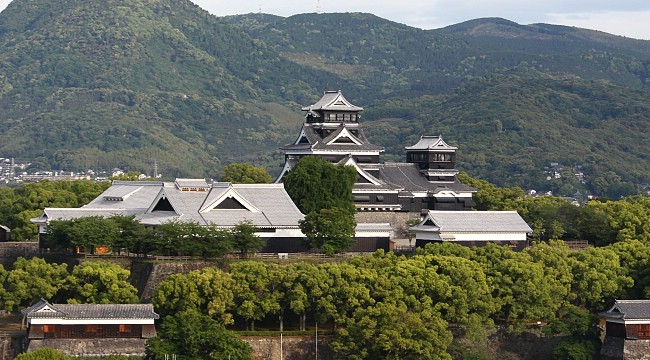
I rode the Shinkansen (finally) after leaving Huis Ten Bosch, and I was literally in Kumamoto station in a matter of 30 minutes. Bullet trains are insanely cool. The woman next to me, also going to Kumamoto, agreed with me that it’s a bit like stepping into a spaceship or a teleporter. I immediately went to visit Kumamoto Castle, the stage for the Satsuma Rebellion in 1877 that saw it burnt to the ground. Once again, many years later, this castle listed as one of Japan’s top three is partially devastated. Since 2016 when a 6.2 magnitude earthquake struck Kumamoto prefecture, the castle has been in intense and precise repairs.
It doesn’t take away from the sheer scale of the castle, and the fact that it took a natural disaster of an unnatural scale to shake it to its foundations is impressive. Walls spilling out onto the moats, turrets completely erased and entire gates brought to their knees: one could just as well have been walking into the aftermath of a bloody battle. The cranes and scaffolds that now brace the ailing structure are a keen reminder of how much history this place has seen, and what it means to the people who live in its shadow every day.
It’s at this point that it decided to rain at a biblical scale for my second time during this trip. I barely made it on to the streetcar and back to the hostel, where I shamefully ran across the street later into the station to get some fried chicken for my dinner…
Luckily I woke up to a dry forecast, and decided to pick up where I left off yesterday. The Suizenji Jōjuen garden was in my plans, and it was worth it. Even with the overcast skies, there isn’t really much to complain about with this place. It felt like being in Tellytubby land, the picture will help you better understand what I mean.
Jumping back on the streetcar, almost identical to the ones in Nagasaki and every bit just as unstable, I also wanted to visit the residence of the Hosokawa clan, the last feudal lords of Kumamoto prefecture. Only a short walk away from the castle the estate felt like it would be an ample replacement for having been deprived of the view of Kumamoto Castle in all its glory.
I found it shut, also under scaffolds and tarps… the walls spilling over like water and the wooden structure twisted and splintered. A sorry sight, but a harsh reminder of the volatile environment that is Kumamoto, Kyūshu and Japan in general. The Kumamoto Prefectural Museum of Art had to do instead, with a brief but fascinating history lesson on the resident feudal lords of old.
It was also sad to read online that the famous Kumamoto Oysters that I wanted to try no longer existed in their place of origin. Extinct in Japan due to poor crop management and pollution in the Ariake sea, these delicious little oysters that are world-renowned simply aren’t a thing in Japan.
Arguably a more disappointing episode of this trip. But I have high hopes for my last few days alone, where I will go all the way south to Kagoshima and further, and the finally find myself in Hiroshima, which will be a good place to explore more of Western Honshu. I just hope the weather holds out !
It goes without saying that a name like Huis Ten Bosch doesn’t exactly scream Japanese. Although, given the Dutch’s historic presence in Nagasaki Prefecture, especially on their trading post of Dejima in Nagasaki, it seems to fit in bizarrely well on the shores of Ōmura Bay. A life-scale recreation of the Netherlands, the streets are lined with Amsterdam-esque buildings and churches and canals. It’s an oddity in any case.
This wasn’t really why I came here though, it’s easy enough for to see the real thing for itself, and a £50 entry ticket to a mock Dutch city theme park didn’t sound too appealing. My real quest was to go to the beach, to quote Mr Bean. And what better place to do it than here, in Ōmura Bay where the inland sea dotted with islands would give Thai resorts a run for their scenic money.
In Beppu, and in Nagasaki, and even in Fukuoka, I was disappointed to find that going to the beach doesn’t really seem like much of a thing here. All these locations are seaside, yet as I mentioned yesterday, the sea fronts are laden with concrete walls and car parks. I was greeted at Huis Ten Bosch station by the charming Michi, whose house I am staying in tonight. I have an adorable little Japanese-style room to myself. His house is a little outside of HTB, but he drove me and my rucksack to a small peninsula in the bay where there was a bathhouse, and lo and behold, a beach. An actual sand beach. Sure, it was enclosed, with safety buoys and an ugly sea wall, but there was sand and there was seawater. Don’t get me wrong, I like pools and hot springs, but at heart I’m an ocean kind of guy.
After a brief conversation with the workers, they let me come down onto the beach which they were “preparing” (???) in order so that I could have a swim. I was then left by Michi to my own devices. To clarify, to me beaches in Japan seem to be public but also not public ? They open only after the rainy season (which happens to end next week) only for summer. It’s a bit bizarre, and kind of defeats the purpose for me but it didn’t matter because the smell of salt water on my skin and in my hair was so refreshing and rewarding that all these questions floated away on the gentle swell. It’s not every day you get a beach to yourself.
The beach being officially “closed”, there was no shower. So, I trekked up the hill to the bathhouse to basically spend the rest of the evening soaking and eating and admiring the view of the bay from the outside bath. I had a pretty good late lunch too. With vending machines and even gambling machines, you could literally spend your entire day in the bathhouse and never have to leave.
I was relaxed, drowsy, sated and clean, and I walked back towards the local station that was between the bathhouse/beach and HTB. A walk along the sea where the sun set behind soft clouds and a misty horizon as the day’s heat started to dissipate. The evenings in this kind of weather are surreal and slightly magical with their hazy light.
I met up with Michi again after having grabbed a snack at the HTB Family Mart, in a weird spot outside the theme park where music was blaring for apparently only me, under the massive hotel that looked like it had been ripped straight out of Copenhagen. Weird, to say the least. I am going to relish this night’s sleep in my own room before I head out to Kumamoto tomorrow morning.
My apologies for not posting a blog last night, I needed a bit of rest. It’s been moving extremely fast since the start, and coming to the hot spring town of Beppu seemed an appropriate place to let off some steam (pun intended).
Beppu lies on the northeastern coast of Kyūshu, in a shielded bay. I got here relatively late in the day yesterday from Nagasaki, but Beppu being a spa destination for Japanese tourists, I was in no mood to rush. Beppu’s springs are historically known for their mineral-rich waters, and the sick and ailing from all over Japan were known to come to this location to benefit from the healing properties of the water. It seems like this heritage lives on, as I spied a great many wheelchairs, zimmer frames and walking sticks on my way out of the station, all with the same hopeful gleam in their eyes.
Baggages dropped, I decided to go to the Kannawa Onsen (the centre of Beppu’s onsen activity and the most widely-known). It was a pretty long bus ride away, and I was surprised to find the streets completely empty. I wanted to visit the Jigoku Onsen, the “Five Hells”; water pools where boiling hot mineral water bubbles to the surface in a furious boil. I was annoyed, and disappointed, to find them closed… However, I did benefit from a free “foot onsen” that is common around this area. Steam literally pours from the ground here, and the bathhouses on every street corner are not shy to advertise that their baths are the best in all the onsen.
I returned back towards where my hostel was. The Takegawara bathhouse might not be the most luxurious bathhouse in town, but it is certainly one of those with the most charm, and also the most highly recommended in Beppu. Although before, I wanted to catch the sunset on the seaside – and I did. It was beautiful, and the bay was as slick as oil, but the stern seafront with its seawalls and lack of beaches was slightly disheartening. It strikes me now that the reasons for this are the constant threat of tsunamis from the deep sea, hence Beppu’s concrete seafront.
Back to Takegawara, I’d forgotten just how hot onsen are. Scorchingly hot, and a completely different sensation to anything else, being almost completely submerged. I was used to saunas, and in my mind these were not so different – I lasted 10 minutes at most, and was in the water at 3 separate intervals broken up by splashings of cold water and a spinning head. However, it seemed that this was the trend for all the local visitors too: arrive, wash, get in the water, get out, rinse, leave. I admit the bone-deep feeling of relaxation post-onsen is unparalleled… And for a mere 100 Yen, who can say no ?
My body as limp as a drunkard’s, I found myself eating dinner first in a small Izakaya (like a pub) followed by a sushi bar, where I was bought drinks and some sushi by some nice guys at the bar… my sleep was indescribable.
My plan the next say was to rent a bike at Beppu’s Giant store, get on a local train and cycle the Kunisaki peninsula and discover the temples and shrines lost in the deep volcanic forests. I found the store to be closed only on Tuesdays, and I was very irritated. A sad McDonald’s later (comfort food), I plucked up the courage to get on a different train to Usuki, the site of the Usuki Sekibutsu – stone-carved Buddhas. I picked up a bike for free at the station, so in sum, my day wasn’t that much of a failure after all.
A sweaty bike ride through the old samurai town of Usuki later, a small museum and hillside greets me. The restored, and preserved, Buddhas sit proudly and mysteriously overlooking the countryside. Said to have been carved in the late Heian Period (794-1185), these stone Buddhas are the only ones in Japan to be bestowed the title of National Treasure. It was moving, and I would have stayed provided that I wasn’t dying for a shower and a glass of water.
My bike and I floated back towards Usuki on the breeze in the late afternoon glow. Back in Beppu, a different bathhouse awaited me, of which’s temperature was considerably more manageable. My supermarket dinner was sat happily in the fridge, and I sit here now, belly full, and the satisfaction of knowing not to have entirely wasted these two days.
A city where steam billows from the streets and hot water seeps from cracks in the rocks; one where people know the meaning of calm. A sleepy, seaside city that in my mind only has the place of rest and recuperation – Beppu, until next time.
That would be like the splendour of the Mighty One…
I am become Death,
The destroyer of worlds.”
As Robert Oppenheimer quoted the Bhagavad Gita upon witnessing the first successful test of the world’s first atomic bomb on July 15th 1945, little did he know how true those ancient and earth-shattering words would ring come August of the same year. And it is these words, and Oppenheimer’s sad realisation at his monstrous creation, that have been with me today as I walked the streets of Nagasaki. A sobering and humbling afternoon to put it simply.
The train ride from Hakata did not prepare me for what I was about to experience. The atomic bombings of Hiroshima and Nagasaki are casually swept over in history class at school, always presented as the final victory and grand finale of the theatre of the Second World War. The reality is much different. The Nagasaki Atomic Bomb museum (原爆資料館) is only a couple of charming streetcar stops away from the station where my hostel is located, and the elegant and to-the-point museum is poignant and brutally blunt. It would have been impossible for me to have been in Kyūshu without coming face to face with the suffering and loss that was experienced here in Nagasaki. I wept for the 75,000 that were vaporised instantly in front of the testimonies of the survivors.
Testimonies of children who buried their mothers, husbands who buried their wives, and sisters who buried their brothers. The inhumanity of such an attack is unspeakable. I can only give credit to the museum for rightfully bringing me (and others) to tears over this act, not to mention over the thousands more who died in the years afterwards.
But it is the resilience of Nagasaki, and of the Japanese people in general, that struck me the most. The will to carry on, to never give up, something that I picked up on vaguely many years ago in David Pilling’s Bending Adversity (read it, it’s incredible). The beautiful peace park that follows the museum, and the sombre memorial to the dead along with the preserved hypocenter (ground zero) along a beautiful little canal, is testament to how much this city is committed to preventing conflict and to moving on upwards from disaster. It’s heartwarming to walk these lively and upbeat streets today knowing that underneath them lay a nuclear wasteland of suffering only 73 years ago. I anticipate to find very much the same thing when I get to Hiroshima in a week.
The will to carry on. That is what I have managed to summarise Nagasaki, Japan’s historical cultural front to the world and a beacon of hope and strength in the south of a once war-ridden country, in one short day. An impression that genuinely made me appreciate sitting in front of my kaisendon on the quayside tonight.
I pray (using the term loosely) that my generation, my brothers’ generations and those to come never have to experience the horrors of war that I have seen today. I will leave this city tomorrow more grateful for my life and grateful to be living in security than I was before I stepped off the train this morning.
I implore you all – those who are reading this – to go tonight to the Nagasaki Atomic Bomb museum’s English site and read for yourselves what you weren’t taught in GCSE history.
As per the title, it rained today. And by rain, I mean torrential. I can’t think of another time when i’ve been under so much of it, and I guess I paid for not being more aware of this Japanese seasonal oddity. For my last day in Fukuoka, I can’t say there was much more on my list I had to see. Yet, there were a couple of things that remained, and the rain only added a more magical and surreal feeling to where I went.
Following on from last night’s conclusion, I did go out in town to experience a bit of the nightlife – the banks of the Naka river, lined with their characteristic yatai (food stalls) glowed with a homely feel in the darkness below the neon lights of the Nakasu district. Heaving with people and the thick smell of pork broth, a Tonkotsu ramen was in order. Accompanied with chicken heart yakitori skewers. And a beer (of course). Although surprisingly, this turned out to be one of my more expensive meals yet, it was hard to fault the deliciousness of my dinner. Youtube channels and tripadvisor had strongly recommended these places as unique social places, and had warned about the touristy price of food here, it felt good to tick off one of Fukuoka’s most iconic things to experience before I left. I can’t say that it was as social as was sold to me, as the constant turnover of people meant it was quite difficult to strike up a conversation, besides the fact that everyone I try to talk to only wants to practice their English, making conversation quite clunky as I desperately try to force them to speak Japanese to me.
That aside, I wound up in quite a nice bar, filled with businessmen and businesswomen getting their drinks for the evening. I paid 500 Yen for a glass of sake (my first), and to describe it concisely: strong, fruity, and ice cold. Although I did wake up with an unfamiliar feeling in my stomach and many bizarre dreams. Maybe I can’t stomach it, who knows. At least now though, I will know what sake is like.
As I mentioned, I woke up to rainfall like I’d never believed was possible. I still got on the train to Nanzōin, about 20 minutes east. This is a tiny little town, at its centre in the hills of cedar trees a giant reclining bronze Buddha, said to be the largest bronze statue in the world. Less spectacularly however, and quite amusingly, is that it was built in 1995 by a monk who apparently won the lottery. But this in no way takes away from the sheer scale and awe-inspiring statue. Perhaps it doesn’t quite have that more venerable quality as the Nara Buddha does, but the size is enough to impress any visitor. And under the pouring rain, his serene smile seemed to mock me as I stood under my pathetic Seven-Eleven umbrella in my soaked Reeboks taking photos on my blurry iPhone.
The rest of the temple complex is buried deep in the forest, through steep winding stone paths lined with torii gates and incense altars. The warm smell of incense and damp earth drowned out the rivers of rainwater that cascaded over the path, but the climb was worth it perhaps not for the very small shrine, but for the backdrop of looming cedars in the light of storm clouds. And being completely alone apart from a couple of distressed hornets who had made their home in the shrine, perfectly quiet calmness fills one up in this tiny, lost little place.
I wanted to stop in the Sasaguri forest on the way back, where there was supposed one of the most picturesque walks and forest in all of Kyūshu, but as you can imagine, the weather and my socks had other ideas.
I found myself once again in Tenjin station, somewhat with a pleasant feeling of closure and yet with a comfortable feeling that there was more for me here to discover. My day couldn’t have felt any more spiritual if the landlady hadn’t offered me some fried chicken and a glass of beer as she ate with her family beside me in the hostel.
It’s been a great first stop in my Japanese journey. Tomorrow, Nagasaki calls.
Another incredible day has passed, and yet I have only been in Asia for a week, let alone in Japan for 2 days. It feels like I’ve been here forever but I have seen so little. A relatively quiet day to say the least, I spent it walking around the port and fish market areas, and ending it in one of my new favourite parks in the world; Ōhori Park. And I also wasted about 1,500 Yen on a new battery and film for my camera to see if it might fix the problem. It didn’t. My irritation is indescribable and my wallet hates me.
As I mentioned, I sweatily furrowed around the local Bic Camera superstore in Tenjin in search of a 3V battery, which is notoriously hard to find. I exit the store, relieved, thinking my issues to be over only to find that the insufferable beeping of my camera is still there and the lens refuses to come out of the body. New film changed nothing either.
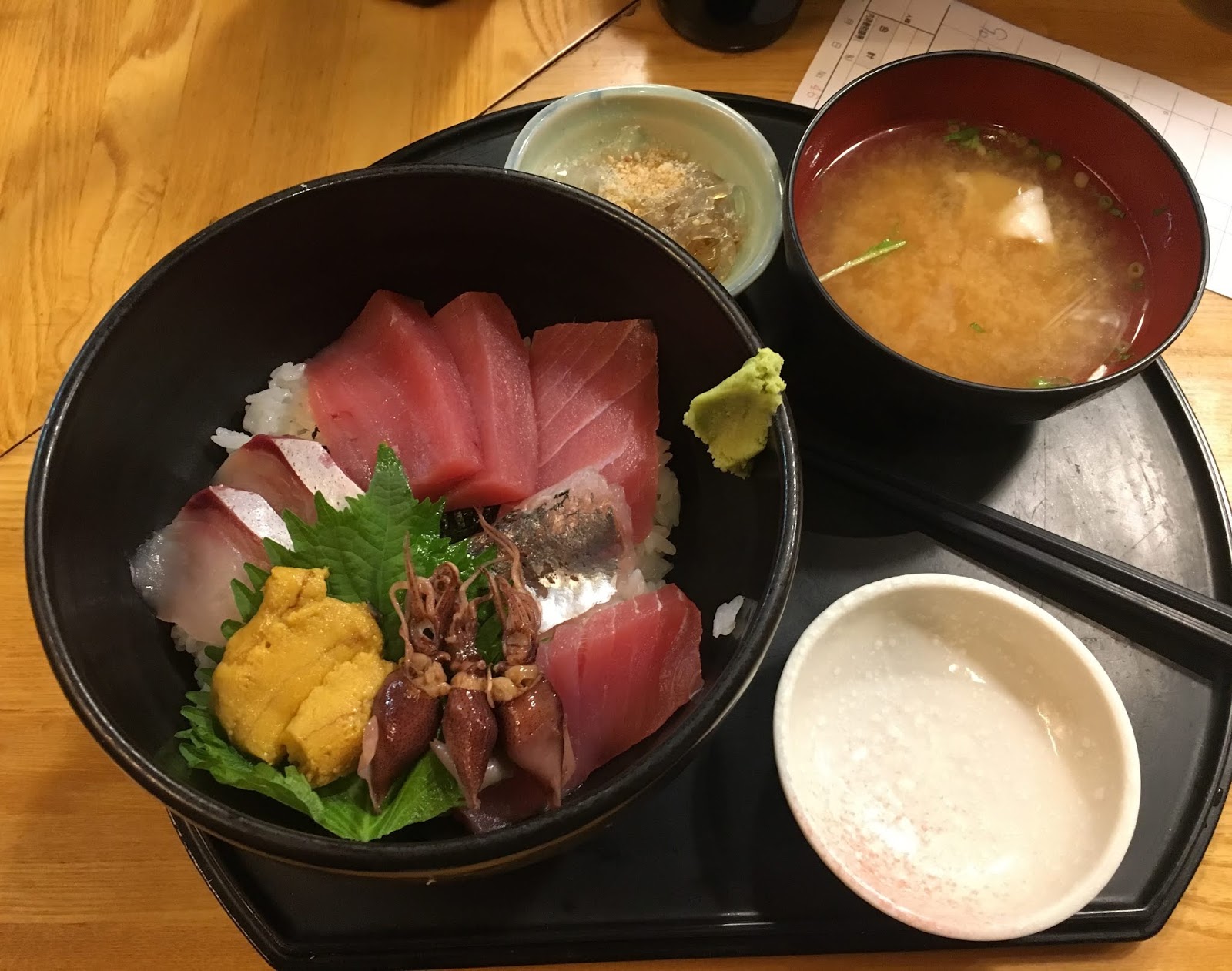
Sadness aside, My mission was to get to the fish market. I had read that you aren’t exactly allowed inside the actual market apart from on only 1 day of each month, but obviously I hadn’t checked so I just went anyway. Naturally, I got lost. Or to be more specific, I was too intimated by the security guards at the entry to the market so I just carried on nonchalantly. As if a tall white European boy could ever look inconspicuous whilst randomly strolling through Nagahama… This actually took me on a nice detour to the port, where I attracted several strange looks from a woman walking out of her house and an old man on a bike who cycled past me. The Seven-Eleven’s wifi allowed me to then rack up the courage to walk back to the market with actual directions, where I found the restaurant I was looking for, and what followed was perhaps the best kaisendon I’d ever have in my life.
For a mere 1,080 yen (£7.56). I’d not had sea urchin in many, many years, and it is just one of the most incredible flavours on this good earth. Not to mention the generous assortment of tuna, yellowtail amberjack and baby squid. 10/10. Market food is the greatest, freshest, cheapest way to experience proper Japanese seafood.
After picking up a bag of chips and an ice-cold Asahi, I made my way down to what is undoubtedly the most magnificent spot in all Fukuoka; Ōhori Park and the Fukuoka castle ruins. Also preceded by a tiny little Japanese garden sandwiched between the ruins and Ōhori Park. I have never seen so many dragonflies in one place at one time.
Ōhori Park is a large lake. It has a couple of islands that stretch across the middle of it, joined together by bridges, so the very middle of the lake makes for a very relaxing afternoon spot to sit in the shade surrounded by turtles, ducks, and a healthy serving of middle-aged joggers. It makes sense that this is one of the most photogenic places in this city. Crystal-clear blue waters under a blue sky on a hot July day is a recipe for any perfect picture, but on top of that a perfect place to lie down and catch a quiet breath from the ever-moving Japanese city life.
Tonight, I think I shall go out. I want to go out in town at night, and see what it’s like to live this city after hours. I might even swing by the park again later – it’s not like I’m about to catch a cold by being outside anyways.
I am back. That’s the overriding feeling in my heart at the moment. I am back in a country that my love for is certainly no new thing, and will undoubtedly be strengthened every time I come back in the future. I am back, but in reality I was back yesterday although I definitely needed those 18 hours of sleep… my apologies for skipping out a day. Put it to a combination of very little sleep during my journey here and a hearty lunch of tonkotsu ramen, gyōza and a beer. In any case, I think I made the most of yesterday and today:
For those who don’t know, Fukuoka sits on the northwestern coast of Japan’s most southern island, Kyūshu. Similarly to my situation upon arriving in Hanoi, check-in at my accommodation was later on in the day. This meant that when I arrived in Fukuoka at 8, I was going to be on my feet for all the day until check-in, which I was overjoyed about. I turned up at the hostel before it opened. Therefore I grabbed a quick breakfast of fried chicken and rice at the Family Mart which is literally 1 minute from this place. I dumped my ungainly bag and rucksack with the nice Korean man at the desk and set off. I had a map, a one-day subway pass and rusty Japanese: the city was my oyster.
I head east, and in the vague direction of what my map tells me is a temple and accompanying park. I find it, and find myself completely and utterly alone. I thought this was weird but it was a bit early (very early) when I was walking around. There is nothing more I like than walking around aimlessly with a map in a new city. The temple complex was wonderful. Incredibly serene. There wasn’t a soul in the vicinity. Hall after hall, I roamed what turned out to be the Shofuku-ji Temple of Hakata Old Town until I had seen all of it. It made me fondly remember Hanoi’s Temple of Literature. Soft, muted and discreet, these wooden temples calm the soul. It must be wonderful to worship in these places. A Japanese zen garden and paper shoji doors are unbeatable though (sorry Vietnam).
A short walk away was the Kushida-jinja Shrine. I’ll describe by photos. What really hit hard however, was the proximity in which the two separate yet parallel religions of Buddhism and Shintoism exist. It hammered home the syncretic and habitual nature of religion in Japan; salaraymen on their lunch breaks, schoolchildren, old ladies, couples etc. all pop through for a quick prayer. Religion doesn’t seem particularly religious. It is more habit and tradition. It’s beautiful and harmonious to see the fluid and casual nature of worship in this country, as Michiko Maekawa describes it (Maekawa, 2004). See my dissertation for more on this subject (Chatriot, 2020 – to be written).
After I wolfed down a bowl of ramen as aforementioned and a completely unnecessary beer (the necessity being debatable), I was slammed hard in the face by exhaustion. I checked in to the hostel, climbed up into my little capsule bed, and crashed.
I woke up naturally. I actually am finding more and more than I despise this sensation. My plan was to 1) eat 2) go to the Sumiyoshi Shrine 3) get on a train to see the Dazaifu Tenmangu Shrine. All of these were completed. The Sumiyoshi Shrine is a delightful little shrine in the middle of this bustling metropolis, and the attached Rakusuien garden is just as soothing as any Japanese garden. Walking through the urban temples and shrines accompanied by the chirping of cicadas and the smell of damp cedar wood trees is a slightly surreal experience that I am struggling to come to terms with, as I’m not entirely sure the fact that I am where I am has set in yet.
A short train ride away is Dazaifu. A small touristy town with the self-titled shrine, the train ride emphasises the seemingly-infinite Japanese suburbia that is only broken up by the hills surrounding Fukuoka. I was blessed by the sun poking its head through the blanket of clouds that shrouds Japan during the rainy season, and the balmy 27°C and the breeze made even iPhone pictures look good. Also my film camera seems to have stopped working. I think the battery is dead and I curse it for doing this to me today of all days. I went up the hills to find a small shrine that I assume most tourists did not know about. A hidden gem for sure.
A successful two days. I’ll probably go to bed a normal time tonight, and maybe eat 5 different packs of instant noodles from the Family Mart (because they’re awesome, duh). I saw a hornet today and it rightfully put me in its place as I tried to take a shortcut to a little shrine. I won’t make the succeeding entries as long as this, but this is a two-day gig. I can also confirm that I have readership in 2 different countries thanks to blogspot’s stats tool, so I’m glad to see that at least someone is reading this. I hope it gives you as much pleasure as it does me.
It’s fair to say that waking up in a country completely changes your impression of it. Although I had been out until 1:30 in the local bars and set an alarm for 9:30, I still woke up at 7:30? Something about it bothered me (understandably). Perhaps that it was that I had failed to combat jetlag, or perhaps it was the unfamiliar feeling of a natural wake up after an actually decent night’s sleep… something that isn’t exactly common for those who know me. But what this did bring to me was the sensation of rising and waking up at the same time as my gracious host, Hanoi. It set the pace for my last day, a pace that put me in tune with this vibrant city and this is exactly what I want to nail every time I go to new places – harmony.
I should mention that I was accompanied today by George and Laura (shoutout you guys rule) who called me over to join them while seeing me eat spring rolls and drink beer alone in the bar. Legends.
I’ve never really been one for sweet breakfast, so breakfast consisted of more freshly fried spring rolls, poached eggs and fresh fruit. I don’t think I could have wished for a better start to the day. Except maybe a better internet connection. The plan for the day was to 1) visit the Mausoleum of Ho Chi Minh 2) visit the Temple of Literacy and 3) eat an actual Vietnamese Pho. This seemed simple given that all three of these things are available within a 2.5km radius. But, there is a large soggy catch. You have to also factor in the walking part. The walking part, which feels more like a swim given that every step is equivalent to losing 5 gulps of bottled water. You haven’t actually sweat properly until you can literally feel the sweat passing through your pores in a 33°C humid nightmare.
The Mausoleum of Ho Chi Minh is massive. The building in itself might not be all that massive, but only when you take into account the size of the accompanying parade square, the residence museum behind, and the sheer amount of security at least two blocks in every direction can you understand the profound importance of Ho Chi Minh and what he represents for Vietnam. The Communists love monumentality in the commemoration of their leaders, and it is not by coincidence that the feeling of walking around this place reminded me of being inside the Kremlin. Minus the buckets of sweat. The museum behind it and the small cool rooms of Ho Chi Minh’s residence embellish Ho Chi Minh’s semi-mythical position as a man of the people, in the true Communist meaning of it.
The Temple of Literature is a marvel. If one could describe the Mausoleum as Holy for the Vietnamese, for me this 11th-century Confucian temple is just as holy. Beautifully designed, long straight paths, symmetrical perfectly-kept gardens and soft, muted serene wooden halls that put even the most humble of Japanese temples to shame. The Chinese influence is glaringly obvious. But perhaps this is what makes it beautiful, another piece to the puzzle that is Vietnamese heritage. A place to worship success in studying, it felt particularly gratifying and appropriate to present my student card for a discounted entry. Hoan Kiem lake and this are probably two places I have discovered that will be extremely difficult to not daydream about once I get home.
The day has been long. It has been sweaty. It has been tiring. There was no more fitting way to conclude my time in Hanoi by the epic “train track street” sandwiched between Kham Tien and Le Duan. It’s rare to have bars and restaurants spilling onto actual functional train tracks, as I found out when the train passed less than a metre away from my face. I also almost forgot to mention that I did get a Pho in the end – and yes, it was as good as people say. It was bittersweet climbing into the taxi to the airport, where I am writing this, as I felt that I had had a full taste of what this place could offer me. To bring it back to harmony, it didn’t feel right to leave just as the city began to come alive for the night. A shame for sure, but I won’t let it leave a bad taste in my mouth. And honestly, the Banh Mi I just ate was pretty decent, so Hanoi and I are parting ways on good terms.
There aren’t many other cities where I have experienced so much new in a mere 2 days. Where else would I have showered in a hotel lobby, seen a rat the size of a small dog, been offered more cocaine and more prostitutes than in my entire life whilst also paying my respects to one of the most peaceful men of the 20th century? Hanoi. It’s hard not to love this place. I will be back, and with a vengeance and a thirst for more of the craziness.
Tomorrow I will be in Fukuoka, Japan. I am anxious and excited to rediscover this country, this time on my own so Hiromu Onogi if you’re reading this, I hope you’re proud of me.
Vietnam. The ubiquitous destination to “find yourself” while you get your A-levels or IB remarked for a deferred entry to university. Top Gear did it first, and by the looks of it, they won’t be the last by a long shot. Cynicism aside, Vietnam has always been alluring to me and I can understand how alluring it is to thousands of tourists every year. I can also confirm in multiple cases that motorbiking across Vietnam on a gAp YaH is and can be a life changing experience that I do not overlook.
Vietnam in my mind wore a shroud of mystery. Francis Ford Coppolla’s Apocalypse Now evokeda feeling of intangible curiosity and mystery about this country that would have made Joseph Conrad froth at the mouth. Naturally, this film touches on a slightly more uncomfortable part of Vietnamese cultural identity, and is most likely unfair to use this as a proxy as to how I felt about the country. Nevertheless, the overhanging enchanting mystery of Vietnam has drawn me like a moth to fire, and quite unintentionally at that.
I am sat in my hotel room in the Hoan Kiem district in Hanoi. The air conditioning takes my mind off the sweltering heat outside, and the ruckus of scooters, taxis and vendors on Bat Dan street 5 floors below is soothingly familiar. Hoan Kiem is one of the most remarkable places I have ever seen. The only place I can remember in my memory that comes close is the Jemaa el-Fnaa souk in Marrakech. Old districts of old cities are understandably and frequently crowded, close, and (now) busy – the one thing that I finds unites these kinds of places is that they feel more like organisms than streets and shops. The streets of Hoan Kiem are literally alive.
Food stalls spill onto pavements catering to army officials, grandmothers, men in suits, whilst families of 5 zoom by on their scooter with the daily shopping hanging precariously off the sides. Tourists (myself amongst them) are all too familiar with the traffic situation in Hanoi: red lights and green lights feel like a pure courtesy rather than law. Terror grabbed me when I got off the bus from the airport, but it turns out that navigating the heaving anarchy of Hoan Kiem’s daily traffic is simple. Like schools of fish, the oncoming traffic swarms through you. The incessant honking and shouting of the driivers is the unsaid language that allows for such chaos to function in such a crowded space.
The thing I love the most about discovering new places are the smells. I think I have a particularly strong penchant for associating memory with smell – the smell of my first time in Japan will be engrained in my mind forever, as will the smell of this city (this is the hard part). Let it first be said that Hanoi is hot in July. Hoan Kiem especially oozes with the sharp scents of lemongrass and gasoline, coupled with intoxicating odours of fried meat and the sickly sweet smell of what I can only assume is either durian or festering waste. Hanoi smells heavy. It smells close. Not many people would describe this city like this, but to me this is so intricately part of the animate quality of the city that I feel that it alone can characterise what it feels like to walk down these old streets.
Having arrived in Vietnam at 4:30 this morning, awake since 7:00 the day before and with a check in at 12:00pm, I’ve spent the majority of the morning walking these streets getting my bearings. Bahn Mi, Bun Cha have been the highlights of today’s culinary side. I did not however locate the shop called Bun Cha Obama, blessed by the presence of the former president and endorsed by him… I have however, found my quiet place in Hanoi today. It is hard to describe the calm I felt sitting at the edge of Hoan Kiem lake with a book for 3 hours. Sure, I was asked for 3 interviews with high school kids doing an English project and took 5 photos with 5 different groups of Chinese tourists in the space of an hour. But I didn’t mind. Exiting the Hoan Kiem labyrinth to relax and read by the side of a lake in the shade is an experience that maybe, just maybe, I could put on par with the gappies who found themselves too in Vietnam.
“Should I stay or should I go?” Mick Jones posed the unanswerable question back in 1981, and 37 years ago we still don’t know the answer. Going still might mean double the trouble – but these troubles wander slightly further away from the punk rock problem of an indecisive romantic interest. It’s a question that plagues me and many more of my compatriots who have adopted England’s green and pleasant land as our own, perhaps not draped in an 80’s leather jacket but more in the guise of a growing gulf between the United Kingdom and Europe.
Easy to figure out by now that I’m talking about the elephant of all elephants in the room, Le Brexit, in all its glorious disgrace. My proud status of Franco-Swede now only serves to torment and question my identity as my adoptive homeland grapples with its own. Who am I ??? Qui suis-je ??? Vem är jag ??? Ironically enough, as much as I’ve come to distance myself with being British or being called “English”, I’m considered exactly that in both my home countries. People in my situation now sit in a bizarre uncanny-valley-esque state of ethnic identity – not really one, nor the other.
Brexit represents an affront on the freedom of Europeans. It’s that significant. It defines my future, ostracises my family’s heritage and nullifies theirs and my contributions to a country that we call home.
I don’t have a British passport. I proudly hold my Swedish and French passports as tokens of my belonging to a modern society. Global, international, multilingual. Leave supporters “want their country back” – from who ?? Nationalism, or at the very least, a strange kind of misguided patriotism that bridges xenophobia and ignorance with racist populism, is a strange thing. The idea of being “British”, according to Benedict Anderson, doesn’t really exist – it’s socially constructed. The idea that the Brexiteers have that Britain must be returned to the British is laughable because there is no such thing as vital, ethnically distinct “Britishness”, just as much as there is no “Frenchness” or “Swedishness”. The cultural identity of this country is diverse and multifaceted, and that is what it means to be British. The ignorance of the average Brexiteer seeks to destroy the very essence of being British, ironically.
As time goes on and as our societies reach further out into the global scene, more and more people will be able to claim more than one nationality – a mixed heritage is becoming the norm. It doesn’t really make sense to close borders and close off oneself to the world that is moving in that direction.
Having a mixed heritage was confusing as a child, being educated in England but spoken to in a mix of Swedish and French at home marked my childhood with a longing, a desire to be just like the other kids at school. Something always felt off. Maybe it was the way my lunchbox had “weird” snacks like brown bread and French biscuits rather than Cheesestrings and Walkers’ Salt and Vinegar. I figured out long after that the difference was that I simply just wasn’t a real English boy. Yet, I wanted to be that English boy. As a child it was all I desired, just to feel slightly less alien in my year 4 class. And in the mind of an 8 year old, the seminal question of who I was began to fester.
People often consider me English. Secondary School reeled me in closer to the 8-year old’s ideal of fitting in – the English boy. I could pass for a Brit anywhere for sure. Brexit took that distorted, lonely, badly-adjusted desire and threw it to the bottom of the garbage. Never did I think that my friends and I would go to school and have teachers apologise to us for the thousands of young people who couldn’t vote for their opinions. The idea of being English, or British, disgusts me in the wake of the 23rd of June 2016. The government who said they would stand and fight for us either ran for the hills, turned on us or eventually disappointed us. As close as I could be to British, my state of mind had never been further from it.
Brexit is an embarrassment for the British government. It’s an embarrassment for the British people. The ineptitude of the negotiations reflect poorly on a country that supposedly thinks it is stronger and more independent without the EU. The bickering within the cabinet is comparable to hyenas scrabbling over a carcass. It’s no surprise that the Emmanuel Macron called the Brexiteers “liars” – Brexit means Brexit after all, but the UK government is under the illusion that it will retain all EU privileges and leave all costs and responsibilities behind. And the people who voted for it are suffering too. It’s a costly affair that is neglecting the issues at home such as housing, education, welfare, taxation and immigration in favour of worrying over a decision hailed as England’s redemption that 3 years on has cost the UK 66 billion pounds. This fact doesn’t really need to be elaborated on.
The departure of Theresa May this month is without a doubt the most hilarious and shameful move in British politics to date. The consequences of her blatant power grab that magically changed her view on the UK’s relationship with the EU could not be any more fitting. Modern politics is the separation of a quest for individual power and status from a noble position of authority where one cares for one’s people and one’s country. Driving bitter but necessary negotiations into the ground only to leave it in the hands of even more incompetent people like Boris Johnson or Nigel Farage or others cannot be forgiven by shedding a tear as one resigns.
I once thought that I would have to give up one of my passports in order to claim British citizenship. Luckily, I don’t, and I say luckily because I know that many others will have to. Even with this privilege, I won’t apply for the British passport. Call me ungrateful, but no one is more ungrateful than the British public and government who has so little regard to immigrants who have worked, paid taxes and studied to help this country not fall into ruin. Why should people reject their heritage and their roots just to stay in a country that they’ve given everything to? In the wake of Brexit and June 23rd 2016 it feels more and more like defeat to attempt to claim British citizenship. To lie about my identity, and to take on a label of British in order to just resume my daily life – I’d be living an unforgivable lie to myself and to my heritage of which I am so proud and hold so dear to. It’s a dilemma to which the answer still is just as unclear to me as the Brexit deal itself.
So where does this leave me? And people like you, the reader, who perhaps also hails from a European background, not to mention those who have come from much further? Well, it leaves us behind. Neglected, confused, stuck in our uncanny valley. To bite the bullet and take the high road, abandon everything we’ve worked for, fought for, built and curated in England’s green and pleasant land might not make William Blake turn in his grave but it certainly makes me and many others turn in our sleep every night. Protest. Demand for public opinion. Shout as loud as we can. Boycott Brexit-supporting companies (yes, even spoons). Living in permanent anxiety of whether or not I can stay in my home country doesn’t suit me. The idea of “moving back to ___” doesn’t really make sense – I’ve always lived in London. London is my home. There is perhaps still a place for my parents to go back to, but not for me. And as The Clash plays on in the background in my room, I still don’t know if I should stay or if I should go.
Anderson, Benedict R. O’G. (1991). Imagined communities: reflections on the origin and spread of nationalism. (Revised and extended. ed.). London: Verso.




/cdn.vox-cdn.com/uploads/chorus_image/image/52913243/c44042178f5bce95dd3c61267c90f288_original.0.png)




 Humanposting